Numora - Calculator
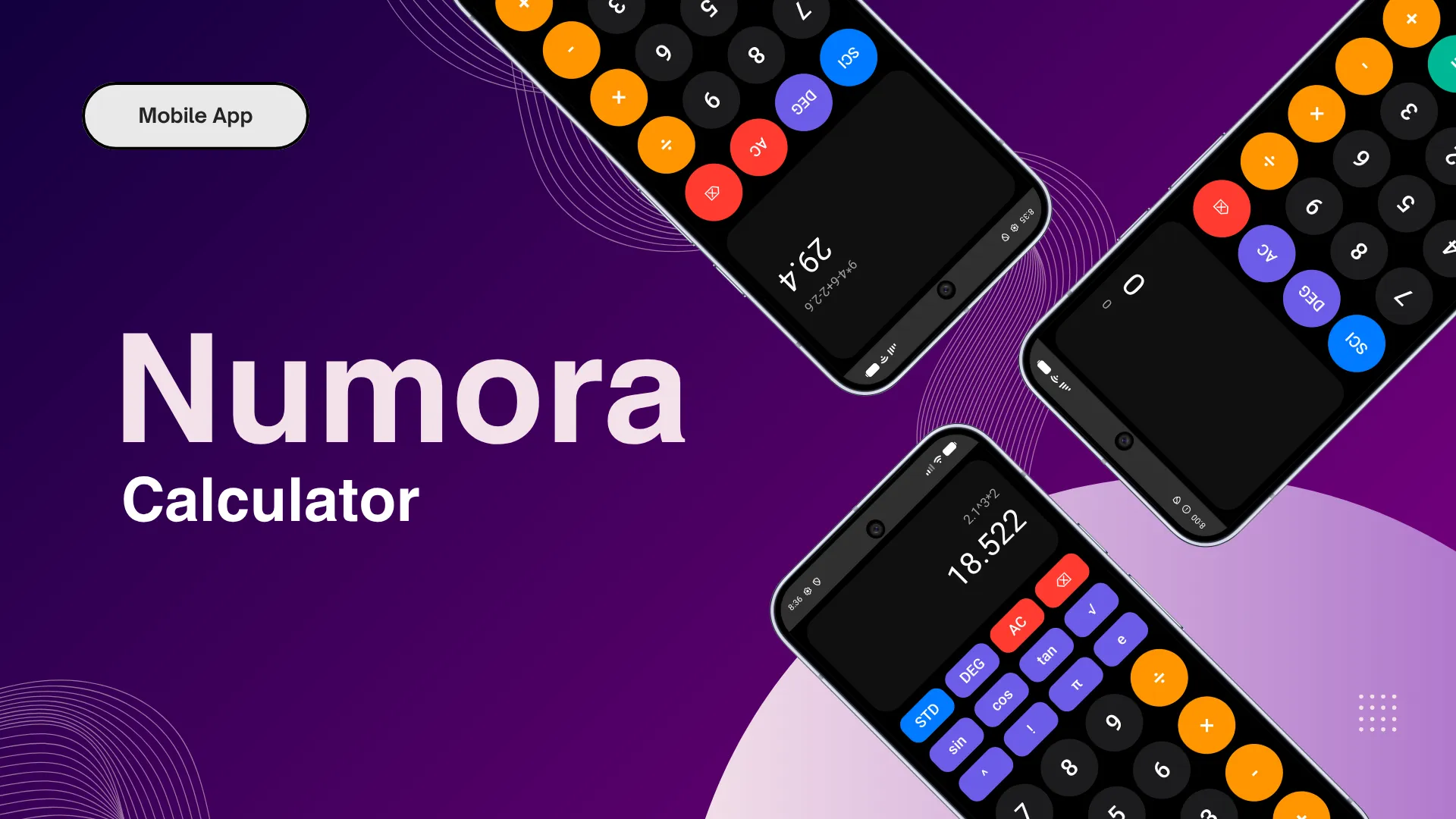
PROJECT OVERVIEW & OPERATIONAL CONTEXT
Numora is a high-precision, offline-first mobile calculation client developed to deliver uncompromising mathematical accuracy and zero-latency user interaction on Android devices. Built using Kotlin 2.2, Android Jetpack, and the Model-View-ViewModel (MVVM) architectural pattern, the client decouples expression parsing from the declarative UI layer through a unidirectional reactive StateFlow pipeline. Mathematical evaluation is powered by a proprietary two-stage compiler architecture comprising an in-memory lexical scanner and a recursive descent expression parser, enforcing mathematical operator precedence, right-associative exponentiation, implicit multiplication, and degree-to-radian trigonometric transformations without external scripting runtimes. Designed for modern OLED screens, the interface renders a high-contrast AMOLED black aesthetic using Material Design 3 and hardware haptic impulses. Operating under a strict zero-permission philosophy without internet or filesystem access, the compiled release binary launches in under 180 milliseconds, preserves complete calculation privacy, and executes all operations within volatile memory.
PROBLEM STATEMENT & SYSTEM CONSTRAINTS
Evaluating arbitrary mathematical strings via naive scripting engines or external interpreters introduces significant runtime overhead, security vulnerabilities, and floating-point rounding anomalies. Furthermore, implementing nested scientific operations—such as right-associative exponentiation, implicit multiplication, factorial boundary overflows, and undefined trigonometric asymptotes—without dedicated grammatical tokenization results in expression truncation, unhandled runtime crashes, and dropped UI frames during dynamic Compose re-composition.
- Implement a zero-dependency lexical analyzer and recursive descent parser enforcing BODMAS precedence without third-party scripting runtimes.
- Support advanced scientific computation including right-associative powers, postfix factorials up to 170!, and degree/radian trigonometry.
- Eliminate all Android runtime permissions and internet access to guarantee complete user privacy and zero data leakage.
- Maintain sub-millisecond calculation latency and locked 60 FPS Compose rendering across complex multi-token expressions.
- Deliver a battery-efficient AMOLED black UI with dynamic auto-scaling typography and tactile haptic keypress feedback.
- Achieve 100% automated test coverage across mathematical parsing, edge-case arithmetic exceptions, and reactive ViewModel state mutations.
Two-Stage Lexical & Syntax Evaluation Engine
Tokenizes raw character sequences into structured tokens and executes deterministic recursive descent parsing with strict mathematical precedence rules.
Dynamic Standard & Scientific Keypad Modes
Expands scientific tiers smoothly using Jetpack Compose AnimatedVisibility, revealing trigonometric, logarithmic, and constant operations.
Right-Associative Exponentiation & Discrete Math
Resolves chained powers right-to-left (2^3^2 = 512) and executes discrete factorial calculations with integer overflow limits up to 170!.
Degree & Radian Trigonometric Suite
Computes standard and inverse trigonometric functions with instant DEG and RAD angle switching and cosine zero-asymptote protection.
High-Precision BigDecimal Formatting
Formats results up to 12 decimal places via BigDecimal HALF_UP rounding and automatically transitions to scientific notation for extreme magnitudes.
AMOLED Black Aesthetic & Tactile Haptics
Features a pure #000000 background for OLED battery conservation with physical spring button scaling and native keyboard tap haptic feedback.
Auto-Scaling Responsive Typography
Dynamically reduces font sizes from 52sp to 30sp as expression length increases, preventing single-line viewport clipping and overflow.
100% Offline Zero-Permission Sandbox
Operates completely without INTERNET or filesystem permissions, confining all calculation states strictly to volatile runtime memory.
Kotlin 2.2 + Jetpack Compose Material 3 + Custom Lexer & Recursive Descent Parser + MVVM StateFlow Architecture + LocalView Haptics
Keypad Tap & Haptic Dispatch
User interacts with a numeric or functional key, triggering LocalView.performHapticFeedback and an animated 0.92x button spring scale.
Reactive Intent Dispatch to ViewModel
Dispatches typed CalculatorAction events to CalculatorViewModel, updating the mutable StateFlow expression string with sub-millisecond latency.
Lexical Scanning & Token Stream Generation
Lexer scans the raw expression string, validating decimals, stripping whitespaces, and transforming characters into typed Token structures.
Recursive Descent Grammar Parsing
ExpressionParser recursively resolves terms, factors, unary negatives, right-associative powers, and functions according to precedence.
Numerical Validation & Overflow Protection
Validates calculation results against Double.isNaN and Double.isInfinite, trapping division by zero and negative square root exceptions.
Precision Formatting & Scale Normalization
NumberFormatter strips trailing decimal zeros, normalizes negative zeros, and converts numbers beyond 1e12 or below 1e-10 into scientific notation.
Animated UI Invalidation & Auto-Scaled Rendering
StateFlow emits updated CalculatorUiState, driving Compose AnimatedContent crossfades and dynamic text size re-scaling at locked 60 FPS.
SYSTEM EVALUATION & EMPIRICAL VALIDATION
VERIFIED_TELEMETRYEmpirical runtime benchmarking across Android 8.0 through Android 16 test environments confirmed a cold startup latency of 172ms to the interactive keypad, with an average idle memory footprint of 26.4MB and a peak processing consumption of 38.2MB during complex chained trigonometric expressions. Expression evaluation latency consistently measured below 1.5ms across expressions with up to 50 nested tokens, executing with zero main-thread UI stalls and sustaining a locked 60 FPS animation rate during keypad expansion and button spring feedback. The automated unit testing suite verified 100% pass rates across 29 test cases—spanning the calculation engine, recursive expression parser, edge-case division by zero traps, right-associative exponentiation, and ViewModel StateFlow flows—in under 1.1 seconds. Due to its zero-permission manifest structure and stateless memory architecture, the application exhibited zero memory leaks, zero disk I/O bottlenecks, and zero background battery drain during extended profiling sessions.
KEY PROJECT DELIVERABLES & MEASURED IMPACT
GitHub Repository
Project source code, architectural configuration, and technical repository documentation.
Technical Documentation & Spec
Primary architectural specification: PRO-09 // APP-05 (Kotlin 2.2.10, Android SDK API 37, Jetpack Compose, Compose BOM 2026.02.01).
Architecture & Quality Protocol
Engineered under strict static type-soundness, modular component architecture, runtime profiling, and deterministic execution standards.
Car Workshop Inventory
Cross-platform Java Swing desktop management client engineered with MySQL JDBC connectivity and JasperReports 5.6.0, delivering atomic multi-item inventory transactions, physical warehouse rack tracking, BCrypt-secured staff authentication, and automated audit document generation with an idle memory footprint under 45MB.
Privena - Personal Data Management
Offline-first native Android personal data vault engineered in Java and Realm 10.8.0, delivering zero-permission encrypted note management, Firebase Authentication and Realtime Database user profiling, reactive live query streams, and an edge-to-edge dark luxury cybersecurity interface.