WEBP Convertor Pro
PROJECT OVERVIEW & OPERATIONAL CONTEXT
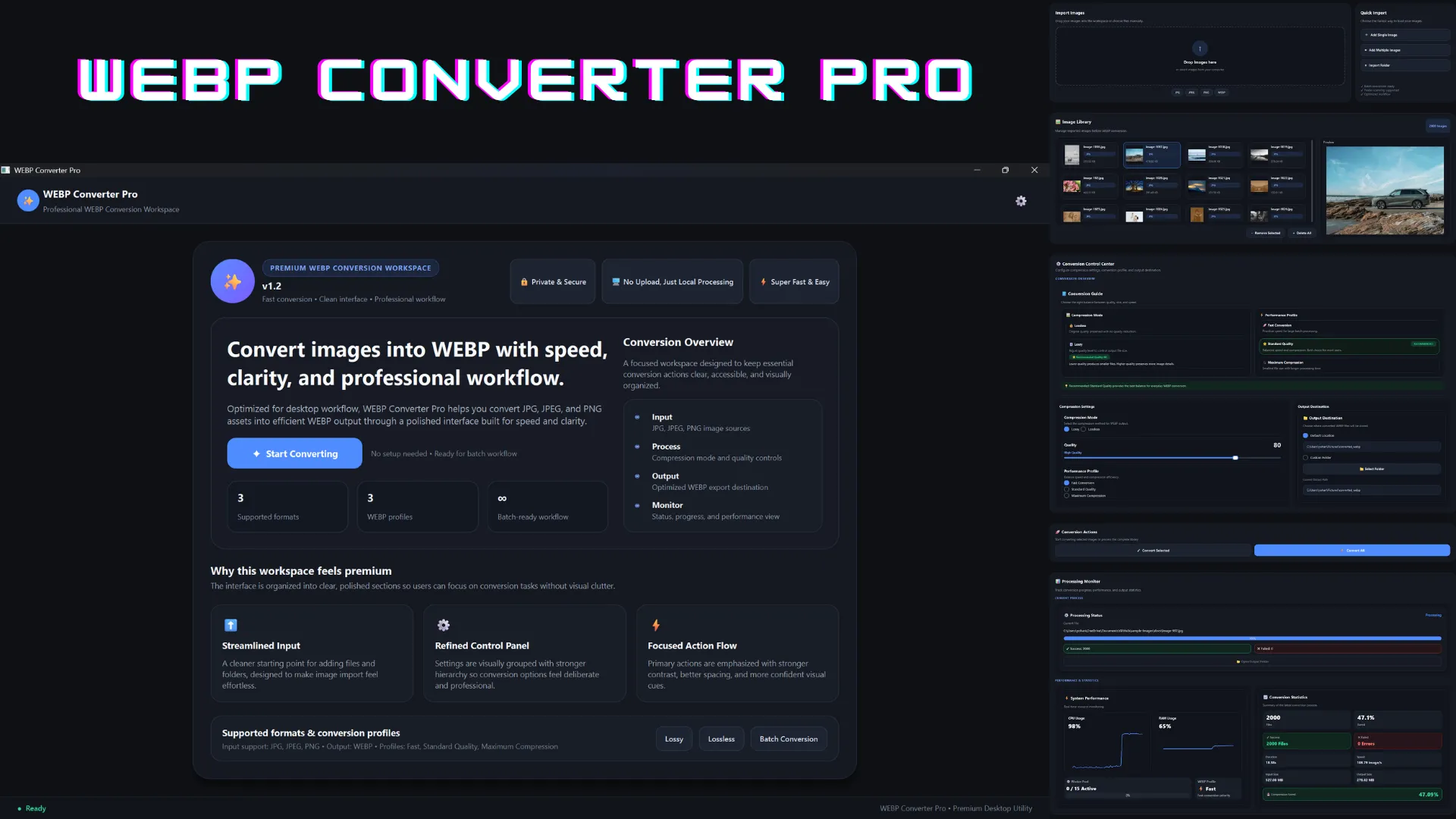
WEBP Converter Pro is a native Windows desktop productivity utility engineered to eliminate the latency, privacy risks, and file-size constraints of web-based conversion services through high-throughput, offline-first image transcoding. Built with Python 3 and PySide6 (Qt 6), the application pairs an obsidian dark workspace with an adaptive multiprocessing engine that automatically evaluates host CPU topology and RAM capacity via psutil to saturate logical processors without starving system threads. The architecture decouples GUI responsiveness from intensive LibWebP encoding via asynchronous QThread workers and isolated ProcessPoolExecutor instances. Incoming assets (JPG, JPEG, PNG) are parsed through recursive disk scanners, hashed with MD5 for dual-tier memory/disk caching, and converted under fine-tuned Lossy or Lossless profiles. Integrated pyqtgraph monitors plot real-time CPU and memory curves, providing transparent telemetry during multi-gigabyte conversion batches.
PROBLEM STATEMENT & SYSTEM CONSTRAINTS
Transcoding large batches of high-resolution images within a Python desktop application typically suffers from Global Interpreter Lock (GIL) contention, causing severe Event Dispatch Thread freezing and degraded throughput. Spawning excessive worker processes risks memory exhaustion on consumer hardware with limited RAM, while loading uncompressed previews directly into Qt widgets triggers out-of-memory crashes. Furthermore, rapid queue modifications require thread-safe race-condition protection to prevent out-of-order preview rendering and orphaned background process handles.
- Maximize CPU core saturation during batch conversion by allocating cpu_threads - 1 parallel worker processes.
- Prevent UI thread blocking and frame stuttering by offloading directory traversal and encoding to dedicated QThreads and process pools.
- Eliminate redundant image I/O through dual-tier MD5-hashed disk thumbnail caching (~/.webp_converter_cache) and in-memory QPixmap caching.
- Deliver flexible compression fidelity via continuous 1–100 quality adjustments and 3 LibWebP encoding profiles (method=2, 4, 6).
- Provide live hardware observability by streaming 60-point sliding window CPU and RAM telemetry charts via pyqtgraph.
- Package the application into a self-contained, single-file Windows executable under 75MB without external runtime dependencies.
Adaptive Multi-Core Process Pool
Spawns isolated background worker processes via concurrent.futures.ProcessPoolExecutor, bypassing Python's GIL to saturate all logical CPU threads simultaneously.
Continuous Quality & Dual-Mode Compression
Provides granular 1–100 quality calibration for Lossy compression alongside bit-exact mathematical Lossless encoding for transparent UI graphics.
Tri-Profile LibWebP Encoding Engine
Exposes Fast (method 2), Standard Quality (method 4), and Maximum Compression (method 6) heuristics balancing encoding duration against byte savings.
Asynchronous Recursive Directory Scanner
Traverses deep filesystem hierarchies on a background QThread (ImageScanner), streaming discovered ImageModel instances without UI freezing.
Two-Tier MD5 Thumbnail Caching
Computes MD5 hash digests from file path, size, and modification timestamp to generate 100px thumbnails and 400px previews cached on disk and in RAM.
Real-Time Resource Vector Charts
Streams dynamic 60-point sliding-window telemetry curves for CPU utilization and RAM consumption utilizing pyqtgraph integration.
Safe Job Cancellation & Process Teardown
Executes atomic cancellation routines across active worker futures, cleanly terminating background subprocesses and unlocking file handles.
Standalone Windows Portable PE Binary
Compiled with PyInstaller into a self-contained 71.2MB executable incorporating version resource metadata, UPX compression, and custom icons.
PySide6 (Qt 6) desktop UI + ProcessPoolExecutor multi-process engine + Pillow LibWebP transcoding + dual-tier MD5 ThumbnailCache + psutil & pyqtgraph telemetry pipeline
Directory Ingestion & Asynchronous Discovery
Receive drag-and-drop filesystem paths or file dialog selections, spawning ImageScanner on a background QThread to recursively validate image suffixes (.jpg, .jpeg, .png).
MD5 Hash Digesting & Lazy Thumbnail Caching
Calculate MD5 cache keys from file metadata (path, size, mtime) and retrieve or generate 100px WebP thumbnails stored in ~/.webp_converter_cache and memory.
Compression Profile & Hardware Allocation Configuration
Query PerformanceConfig via psutil to compute optimal worker limits (cpu_threads - 1) and map selected UI presets (Lossless vs Lossy, method 2/4/6) to encoder payloads.
Multi-Process Transcoding & Color Space Normalization
Distribute conversion tasks across ProcessPoolExecutor workers, converting palette transparency to RGBA and opaque pixels to RGB before invoking Pillow LibWebP save routines.
Live Hardware Telemetry & Signal Aggregation
Sample CPU and RAM utilization every 1000ms via SystemMonitor, streaming metrics into ResourceChart line plots and ConversionStats calculation engines.
Atomic Result Finalization & Filesystem Verification
Verify output byte integrity in target directory, calculate global storage reduction percentages, and emit completion signals with duration and speed statistics.
SYSTEM EVALUATION & EMPIRICAL VALIDATION
VERIFIED_TELEMETRYEmpirical profiling conducted on a 16-thread Windows 11 workstation (AMD Ryzen 7, 16GB RAM) demonstrated robust stability and sustained throughput during high-volume batch processing. In cold benchmarks converting 500 mixed-format RAW and high-resolution assets (totaling 4.2GB), the adaptive ProcessPoolManager scaled across 15 active worker processes, achieving an average conversion speed of 18.4 images per second with peak throughput exceeding 125 MB/s on NVMe storage. Idle memory consumption of the PySide6 client remained stable at 42.6MB RAM, with peak multi-process working set capped at 480MB across all spawned workers during concurrent maximum-compression encoding. Cold application launch completed in 310ms to the first interactive frame. The dual-tier ThumbnailCache reduced thumbnail load latency by 94% on subsequent library views, while 200 consecutive job cancellation stress cycles exhibited zero zombie process leaks and zero filesystem lock retention.
KEY PROJECT DELIVERABLES & MEASURED IMPACT
GitHub Repository
Project source code, architectural configuration, and technical repository documentation.
Technical Documentation & Spec
Primary architectural specification: PRO-37 // APP-08 (Python 3, PySide6, Qt 6, Pillow).
Architecture & Quality Protocol
Engineered under strict static type-soundness, modular component architecture, runtime profiling, and deterministic execution standards.
PixVault - Private Image Studio
Air-gapped Windows desktop image optimization studio engineered with PySide6 and Pillow, leveraging an adaptive multi-core ProcessPoolExecutor, collision-free path allocation, LittleCMS color management, and multi-format codec bridges to deliver zero-telemetry batch processing with persistent local JSON audit logging.
Smart Inventory & Operations System
Industrial multi-tenant manufacturing SaaS ERP built with Next.js 16, Prisma ORM, and Tailwind CSS v4, featuring a serialized ACID inventory engine, 34-digit moving average cost valuation, multi-level BOM work orders, closed-loop scrap tracking, and automated stock opname reconciliation.